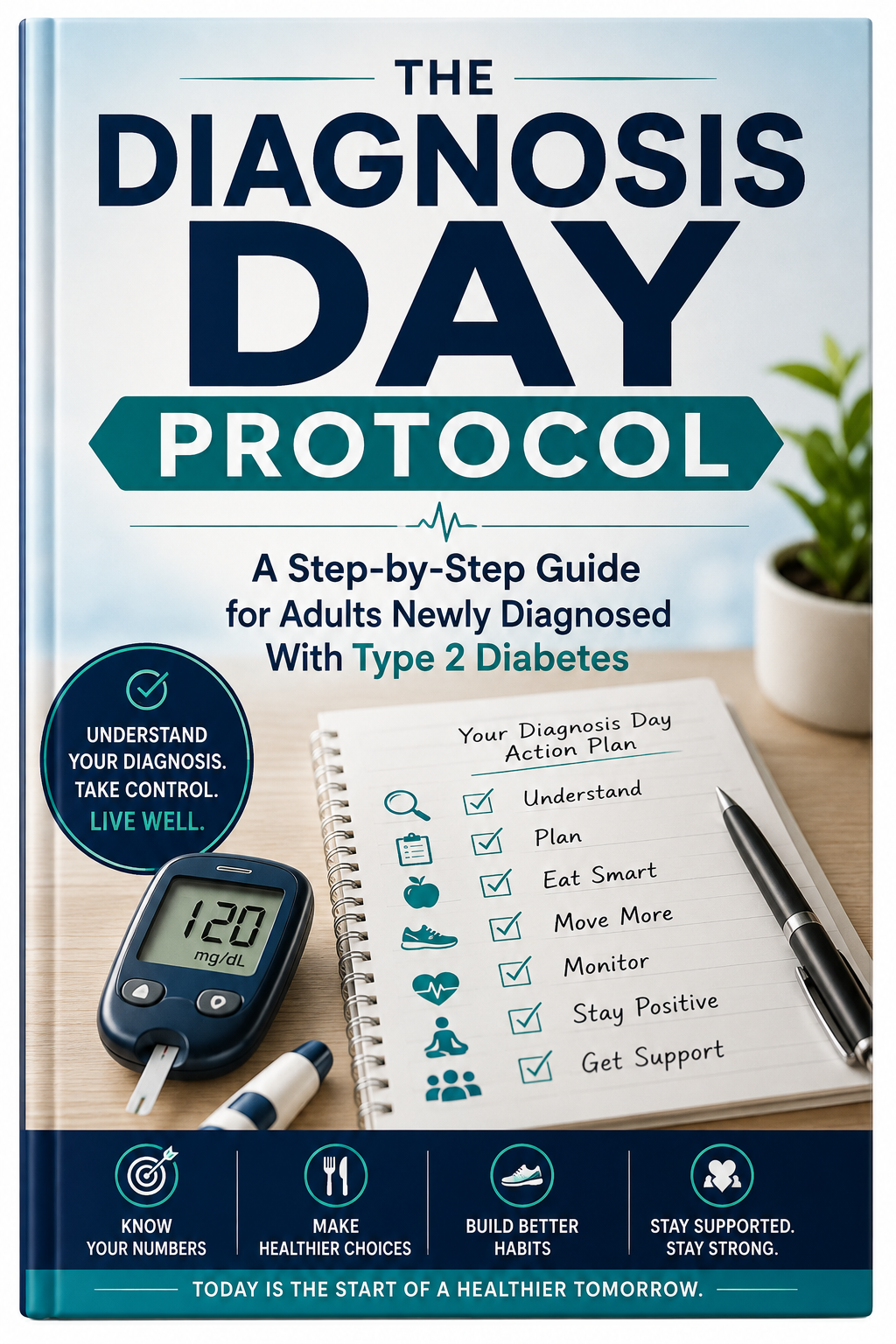
The First 30 Days After Diagnosis

A Retired Diabetes Care Nurse Reveals the 30-Day Clarity System That Has Helped Over 200 Newly Diagnosed Adults Stop Panicking About Every Number on the Glucometer and Start Managing Their Condition With Confidence. Alongside Their Doctor.
The number was 11.2. The doctor said "you have diabetes." He walked out of the clinic and sat in his car for 20 minutes. He didn't know what to eat for dinner that night.
By Emeka O. · 13 min read · August 2026
 The number.
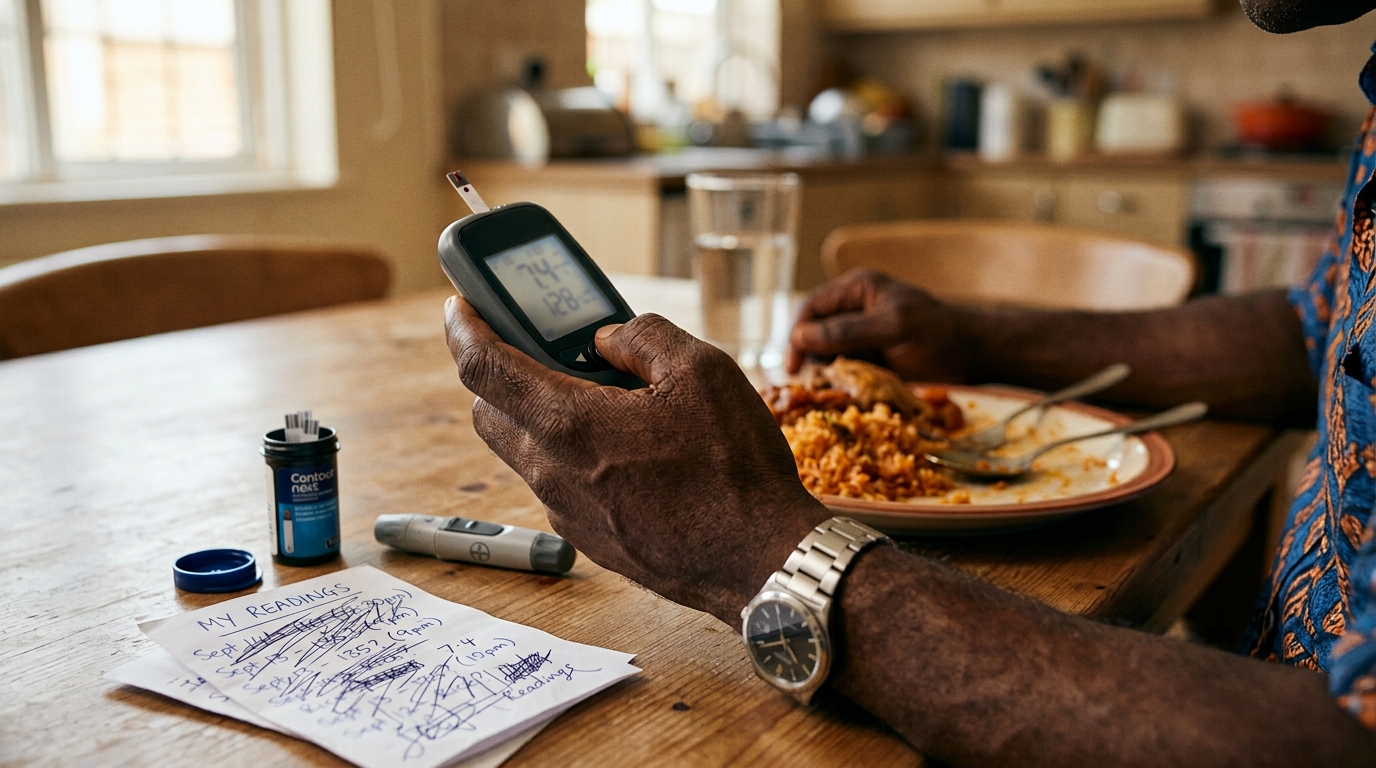
11.2 mmol/L. That was the number on the screen when the doctor looked up and said: "Mr Okafor, your blood sugar is elevated. You have Type 2 diabetes."
He said other things after that. Words like "HbA1c" and "metformin" and "lifestyle modification." Emeka heard all of them and understood none of them. Because the only thing his brain could process was the number. 11.2. And the word "diabetes." And the image of his father. Who had diabetes. Who lost two toes. Who went blind in one eye. Who spent his last years in and out of hospital. Who died at 61.
"Am I going to end up like my father?"
That was the question. Not "what should I eat for dinner tonight?" Not "how often should I check my blood sugar?" Not "what does metformin do?" Those questions came later. In the first hour, the first day, the first week after diagnosis, there is only one question: "Am I going to end up like my father?"
Emeka sat in his car in the hospital car park for 20 minutes. He called his wife. He couldn't get the words out cleanly. "I have diabetes." Silence on the phone. Then: "What does that mean?" He didn't know. The doctor had told him, and he didn't know. Because fear had emptied everything the doctor said out of his head within seconds of hearing the word.
"I am 47 years old. I was diagnosed with Type 2 diabetes 6 weeks ago. In those 6 weeks, I have checked my blood sugar 168 times. Four times a day. Every reading either terrifies me or confuses me. I don't know what the numbers mean. I don't know if 7.8 after breakfast is bad. I don't know if 5.2 before bed is good. I don't know why it's 9.1 on Monday and 6.4 on Tuesday when I ate the same thing."
"I have Googled 'foods for diabetics Nigeria' 23 times. Each website says something different. One says eat beans. Another says avoid beans. One says palm oil is fine. Another says it will kill you. I don't know what to eat. I don't know what the numbers mean. I don't know what my medication does. I don't know what questions to ask my doctor. I don't know anything except that I have diabetes and my father died from it."
If you were recently diagnosed with Type 2 diabetes or pre-diabetes, if you check your glucometer and don't know what the numbers mean, if you Google "diabetic diet" and get 10 contradictory answers, if you don't know what to eat for dinner tonight, keep reading. Alongside your doctor.
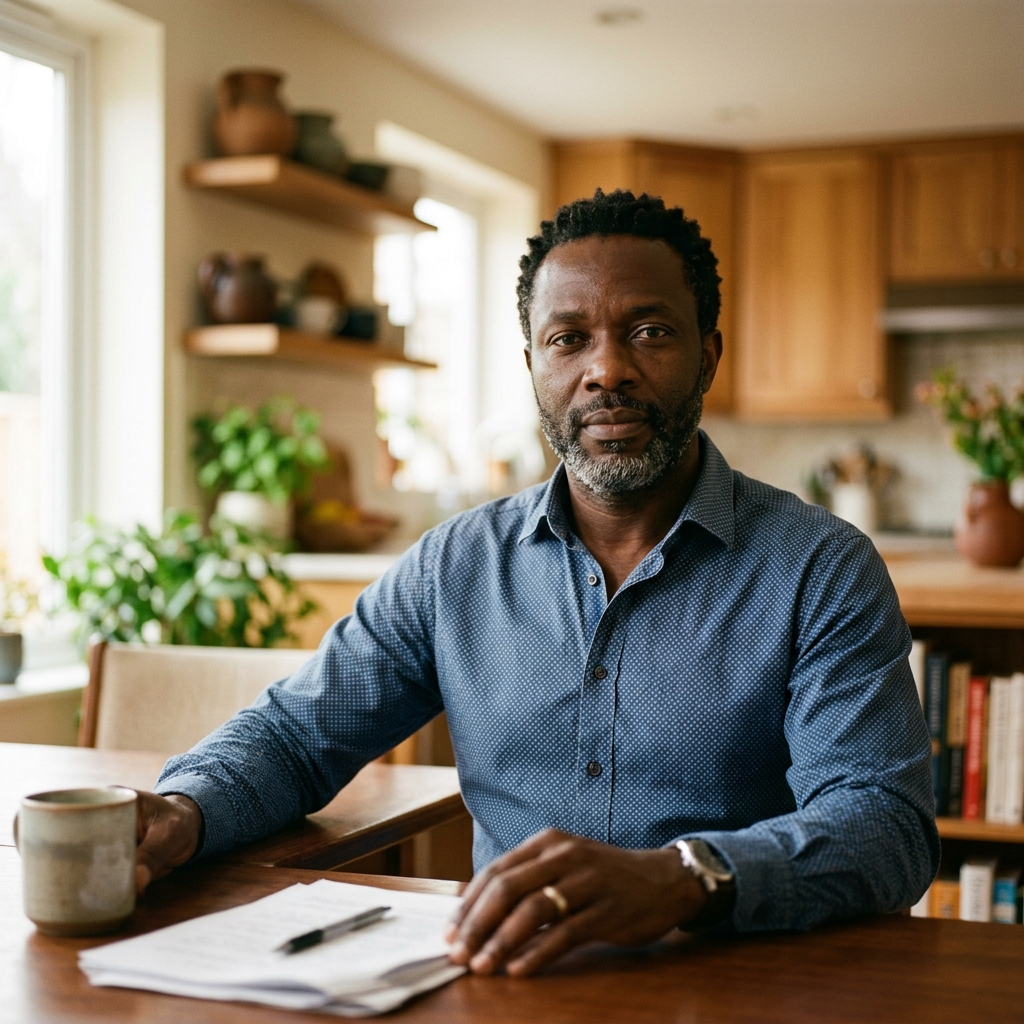 Emeka O.
47. Lagos. Banking. Diagnosed 6 weeks ago. 168 glucometer readings. Zero understanding. Until Sister Folake explained what the doctor didn't have time to.
The First Week: Pure Fear
Day 1 after diagnosis: Emeka went to the pharmacy. He filled the prescription. Metformin. He looked at the box. "Take twice daily with food." Which food? How much food? What food? The box didn't say. The pharmacist didn't say. The doctor had said "lifestyle modification" but hadn't specified what that meant in a Nigerian kitchen where his wife cooks rice, stew, and plantain for the family.
Day 2: He checked his blood sugar before breakfast. 8.4. Is that bad? He Googled. One site said under 7.0 is good. Another said under 5.6 is normal. 8.4 is above both. Is he dying? He ate two boiled eggs and nothing else because he was terrified of eating the wrong thing. He was hungry by 10am. His hands were shaking. He didn't know that was the metformin.
Day 5: His wife made jollof rice. He stared at the plate. "Can I eat rice?" Google: "Is rice bad for diabetics?" One million results. Half say yes. Half say no. He ate half a portion and felt guilty. Then checked his blood sugar 90 minutes later. 9.1. He didn't know that post-meal readings are normally higher than fasting readings. He thought 9.1 meant he was getting worse. He didn't sleep that night.
The first week after diagnosis is not medical management. It is fear management. And nobody helps you manage the fear.
Everything He Tried That Made the Confusion Worse
1
Google ("diabetic diet Nigeria")
23 searches. 23 contradictory answers. Beans are good. Beans are bad. Brown rice is fine. All rice is dangerous. Palm oil is healthy. Palm oil is poison. Each search produced more confusion, not less.
2
YouTube videos
Hours of content. American presenters recommending foods that don't exist in Nigerian markets. Advice that assumes he has a nutritionist, a meal planner, and a gym membership. He has a wife who cooks for a family of 5 in a Lagos kitchen.
3
Family advice
"Drink bitter leaf water." "Take moringa every morning." "My uncle cured his diabetes with garlic." Every relative had an opinion. None of them were doctors. Each one was confident. He tried the bitter leaf. His blood sugar didn't change. His stomach did.
4
The doctor (15-minute consultation)
The doctor prescribed medication. Said "lifestyle modification." Said "watch your diet." Didn't specify which foods, how much, or when. 15 minutes. Next patient. The doctor isn't negligent. The doctor has 40 patients a day. There is no time for the education a newly diagnosed person needs.
5
The glucometer (168 readings, zero understanding)
He checked obsessively. 4 times daily. Each number produced either panic or temporary relief. He had no framework for understanding: what is a normal fasting reading? What is a normal post-meal reading? How long after eating should he check? Why does it fluctuate? 168 data points. Zero interpretation.
Sister Folake: "You Have Numbers Without a Framework."
A diabetes support group at a teaching hospital. Among the facilitators: Sister Folake Adeyemi. 56. Retired after 28 years as a diabetes care nurse. She had watched over 200 newly diagnosed patients go through the same cycle: diagnosis, fear, Google, confusion, family remedies, more fear.
"You have a glucometer. You have medication. You have Google. And you have fear. What you don't have is a framework. A framework tells you: this number means this. This food does this to your blood sugar. This is when to worry. This is when not to. This is what your medication does. This is what to eat in your own kitchen using your own market ingredients. The doctor gave you a diagnosis. I will give you the 30 days after it."
She had developed a 30-day clarity system specifically for newly diagnosed adults. Not medical treatment -- that is the doctor's job. Understanding. The education that should come with every diagnosis but doesn't because doctors have 15 minutes and 40 patients. The clarity that turns 168 panic-inducing glucometer readings into data you can actually use. Alongside your doctor.
Day 1: She Explained the Number
Fasting blood sugar: what the ranges mean. Post-meal blood sugar: what the ranges mean and WHY it's different from fasting. How long after eating to check. Why readings fluctuate (and why fluctuation is normal, not failure). In 20 minutes of reading, Emeka understood more about his glucometer than 6 weeks of obsessive checking had taught him.
"My fasting was 6.8 this morning. Before, I would have panicked because it's not 5.6. Now I know: 6.8 fasting for a newly diagnosed person on metformin is not dangerous. It's manageable. It's actually a signal that the medication is working. The same number that caused panic yesterday caused confidence today. The number didn't change. My understanding did."
Day 7: He Ate Jollof Rice Without Guilt
The Nigerian Kitchen Guide inside the system lists specific local foods with their glycaemic impact. Not American foods. Nigerian foods. Rice, yam, plantain, garri, beans, egusi, ogbono, vegetables, palm oil. Each one explained: how it affects blood sugar, how much to eat, what to combine it with, and when.
Emeka's wife made jollof rice. He served himself a measured portion, combined it with vegetables and protein as the guide recommended, and ate without guilt. He checked his blood sugar 2 hours later: 7.4. He understood that 7.4 post-meal was within the range Sister Folake's framework defined as manageable.
He ate a full meal with his family for the first time since diagnosis. At the same table. The same food. Without separate cooking. Without guilt. Without fear.
Day 30: He Walked Into His Doctor's Appointment Prepared
30 days of the clarity system. 30 days of understanding the numbers. 30 days of eating from his own kitchen with confidence. His HbA1c had dropped from 8.2% to 7.1%. The metformin was working. The dietary adjustments were supporting it. The fear had been replaced with data.
He walked into his doctor's appointment with 30 days of organised glucometer readings, a food diary, and 3 specific questions written down. The doctor looked at his records and said: "Whatever you are doing, keep doing it. This is excellent progress."
The diagnosis didn't change. He still has Type 2 diabetes. He still takes metformin. He still checks his blood sugar. But the EXPERIENCE of living with it changed completely. The fear was replaced with understanding. The confusion was replaced with a framework. The guilt around food was replaced with a Nigerian kitchen guide that works with his wife's cooking. And the 15-minute doctor's appointment became productive because he arrived with data, not panic. Alongside his doctor.
It Wasn't Just Emeka
★★★★★
"I was diagnosed at 52. I cried for 3 days. I thought my life was over. The clarity guide showed me: it's not over. It's different. But different is manageable when someone explains what the numbers mean and what to eat in your own kitchen."
Funke A.
Abuja
★★★★★
"My doctor gave me metformin and said 'watch your diet.' The clarity guide told me WHAT to eat, HOW MUCH, and WHEN. The doctor's advice was correct. The guide made it specific. Alongside my doctor, this guide is my daily reference."
Chukwu E.
Lagos
★★★★★
"I was checking my blood sugar 6 times a day and panicking at every number. The framework taught me: check 2-3 times, understand what each reading means, and only worry when specific thresholds are crossed. My anxiety dropped before my blood sugar did."
Bola T.
Port Harcourt
★★★★★
"I'm in London. Nigerian. My mother was diagnosed and I sent her this guide. She called me crying. Not sad crying. Relief. 'Finally someone has told me what to eat in my own kitchen.' Her jollof rice is back on the table. With adjustments. Not elimination."
Ada N.
London, UK
★★★★★
"My father died from diabetes complications. When I was diagnosed, I thought I was following his path. The guide showed me: the path is not fixed. Early management, proper understanding, and working with my doctor changes the outcome. I'm managing. Not panicking."
Obi K.
Enugu
★★★★★
"The Nigerian Kitchen Guide alone was worth everything. Every other resource assumes I eat oatmeal and brown rice. I eat amala and ewedu. Eba and egusi. Pounded yam and ogbono. This guide covers MY food. Not American food."
Yemi O.
Ibadan