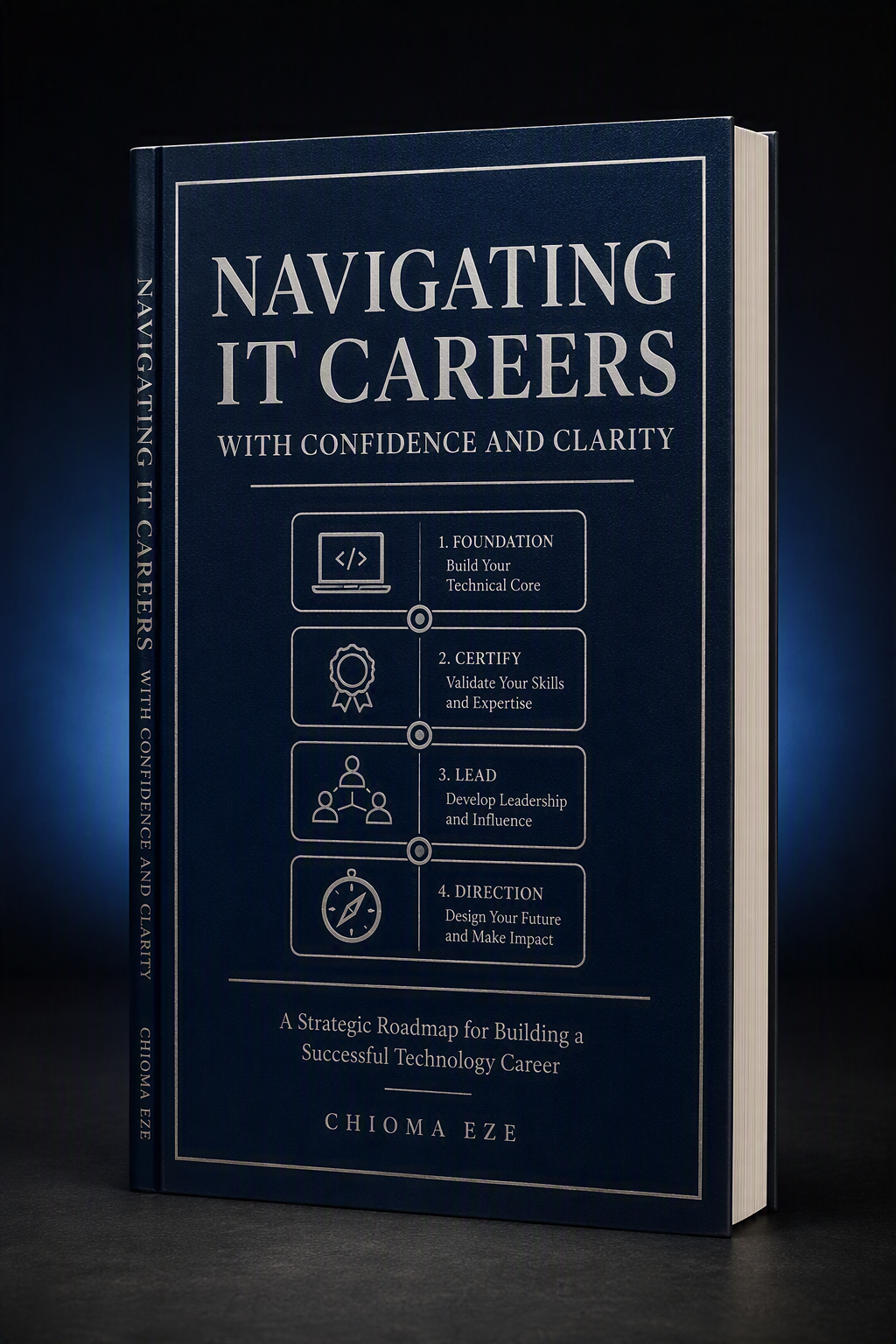
NAVIGATING IT CAREERS WITH CONFIDENCE AND CLARITY

Why I Wrote This Book
My name is Emmanuel Tunde Olugbile.
My journey in technology did not begin with a perfect career plan.
It began with curiosity, education, practical work and many decisions that became clearer only after I gained experience.
I studied Computer Engineering at Covenant University.
Like many young people entering technology, I understood that the industry held opportunities. What was less obvious was how many different careers existed within it.
Information technology was often discussed as though it were one profession.
It was not.
There were network engineers, system administrators, software developers, database professionals, security analysts, cloud engineers, project managers and support specialists.
Each role required a different combination of skills.
Each offered a different daily experience.
Yet students were often told simply:
“Go into IT. There are jobs there.”
That advice sounded useful, but it did not answer the most important questions.
Which part of IT?
What does the work involve?
Does it require coding?
Which skills matter most?
What should a beginner learn first?
How does someone prove that they can do the work?
I began my professional career as a Network Engineer with 21st Century Technologies in Lagos.
My work involved enterprise networking, connectivity, customer equipment, structured cabling, fault resolution and infrastructure deployment.
This was not technology as it appeared in a textbook.
Customers depended on systems that needed to work.
When a connection failed, somebody had to identify the cause.
When equipment could not communicate, somebody had to understand the network well enough to restore the service.
The experience taught me an important lesson:
Knowing the name of a technology is different from knowing how to use it to solve a real problem.
A person could read about networking for months and still struggle to diagnose a basic connectivity fault.
Employers were not interested only in what you had heard.
They wanted evidence that you could think, investigate, communicate and solve problems responsibly.
As my career developed, my responsibilities expanded.
I moved beyond individual network devices into broader areas of information technology.
I worked with servers, user support, infrastructure, cloud platforms, security controls, vendors, budgets, policies and organisational risk.
I later served as Information Technology Lead on the USAID Power Africa Nigeria Power Sector Program delivered by Deloitte Nigeria.
That position exposed me to the reality of running technology in a demanding professional environment.
Technology decisions were never purely technical.
A proposed solution could be impressive and still be unsuitable because it was too expensive, difficult to support or misaligned with the organisation’s needs.
A security measure could be strong and still fail if users did not understand it.
A cloud migration could offer flexibility but also introduce cost, identity, compliance and availability risks.
An IT professional therefore needed more than technical knowledge.
You needed judgement.
You needed communication.
You needed to understand business priorities.
You needed to document your work.
You needed to manage risk.
Most importantly, you needed to keep learning without chasing every new trend.
Over the years, I continued my education.
I completed postgraduate studies in Computer Science and Information Technology. I later specialised further in Information Security and Digital Forensics.
I pursued professional training across networking, cloud computing, Microsoft technologies, cybersecurity, information security management and auditing.
Education helped me grow.
But it also taught me something that many beginners discover too late:
A qualification becomes powerful when you can connect it to practical ability.
A certificate may introduce you to a subject.
It may give structure to your learning.
It may help you pass an employer’s initial screening.
But the certificate cannot answer interview questions for you.
It cannot build a portfolio.
It cannot troubleshoot a failing server.
It cannot explain a security incident to management.
It cannot replace judgement developed through practical work.
I began noticing the same pattern among students, graduates and career changers.
Someone would approach me and say:
“Sir, I want to enter IT. Which course should I take?”
I would ask:
“Which kind of work interests you?”
The answer was often:
“Anything that pays well.”
That response was understandable.
People need income.
Many Nigerians are dealing with unemployment, underemployment, rising living costs and limited opportunities.
A career decision cannot ignore financial reality.
But salary alone cannot tell you whether a career fits you.
I met people who enrolled in programming courses because software development appeared profitable.
After several months, they realised that they did not enjoy building software.
Some preferred working with infrastructure.
Others enjoyed analysing information.
Some were better suited to project coordination, governance, audit, user support or business analysis.
They had not failed.
They had simply started with a course instead of a career decision.
I also met people who collected certifications without building anything.
Their CVs contained impressive terminology.
But when employers asked what they had configured, investigated, documented or delivered, they struggled to provide evidence.
Others became trapped in endless preparation.
They would say:
“I will start applying after one more certification.”
One certification became two.
Two became four.
They continued postponing the moment when their knowledge had to meet the real market.
Another group followed online excitement.
One month, everybody was discussing cybersecurity.
The next month, artificial intelligence became the only career worth considering.
Then blockchain appeared.
Then cloud computing.
The cycle continued.
Each new trend made the previous decision appear outdated.
I understood the confusion because the technology industry changes rapidly.
New tools emerge.
Products are renamed.
Certifications are retired.
Job descriptions evolve.
But beneath those changes, employers continue to value several enduring abilities:
- Solving problems
- Learning independently
- Communicating clearly
- Working responsibly
- Understanding fundamentals
- Producing evidence of competence
- Adapting to changing tools
I began asking a different question.
Instead of asking, “Which technology career is the best?” I asked:
“How can someone make a responsible career decision when the industry keeps changing?”
That question became the foundation of this book.
The answer was not another list of the highest-paying jobs.
It was not a promise that one certification would guarantee employment.
It was not a claim that everybody should learn coding.
The answer was a practical decision framework.
First, you must understand how you prefer to work.
Do you enjoy building things?
Do you like investigating unusual behaviour?
Are you comfortable analysing numbers?
Do you enjoy helping people resolve problems?
Can you coordinate teams and manage deadlines?
Would you rather work deeply with systems or communicate between technical and business teams?
These questions do not decide your career automatically.
They give you a useful starting point.
Second, you must understand the actual work behind a job title.
“Cybersecurity” can mean monitoring security alerts, testing systems, writing policies, managing risk, investigating incidents or protecting cloud platforms.
“Data” can mean cleaning spreadsheets, writing database queries, building data pipelines, producing dashboards or developing predictive models.
“Cloud computing” can involve administration, architecture, security, support, automation or cost management.
A broad career label cannot tell you what your working day will look like.
Third, you must compare your chosen direction with reality.
What do employers request?
Which skills appear repeatedly in entry-level vacancies?
Do the jobs exist in your location?
Can the work be performed remotely?
What experience do employers expect?
Which beginner projects could demonstrate the required abilities?
Fourth, you must test the career before making a major commitment.
You do not need to pay for an expensive programme immediately.
You can begin with a small experiment.
If you are considering data analytics, analyse a public dataset and create a short report.
If you are exploring web development, build a simple working website.
If cloud computing interests you, deploy a basic service while carefully controlling your billing settings.
If you are interested in cybersecurity, create a legal home laboratory and document a defensive security exercise.
If you are considering IT project management, prepare a sample project charter, risk register and progress report.
A small project reveals things that motivational videos cannot.
Did you enjoy the process?
Were you curious when something went wrong?
Did you want to understand the problem more deeply?
Could you imagine improving with practice?
Or did every minute feel unbearable?
That evidence matters.
Finally, you must convert your decision into a focused plan.
Not ten courses.
Not seven career paths.
One direction.
One foundation.
One practical project.
One set of vacancies to study.
One group of professionals to learn from.
One review date.
This became the structure behind Navigating IT Careers with Confidence and Clarity.
I wrote it for the student who is interested in technology but does not know where to begin.
I wrote it for the graduate who fears that years of education have not prepared them for employment.
I wrote it for the professional considering a career change but worried about starting again.
I wrote it for the early-career IT professional who has gained experience but lacks direction.
I also wrote it for parents, teachers, mentors and career advisers trying to guide other people responsibly.
This book does not promise that you will secure a job in 21 days.
No honest author can guarantee that.
It does something more useful.
It helps you understand your options, identify a credible starting point and create a practical plan for moving forward.
You may still need to work hard.
You may need to strengthen your foundations.
You may discover that your first choice does not suit you.
That discovery is not wasted effort.
It is evidence.
The real danger is not changing direction after learning something useful.
The danger is spending years moving without a direction—or remaining motionless because you are afraid of making an imperfect decision.
You do not need to predict the next 20 years.
You need to choose your next responsible step.
That is what this book helps you do.